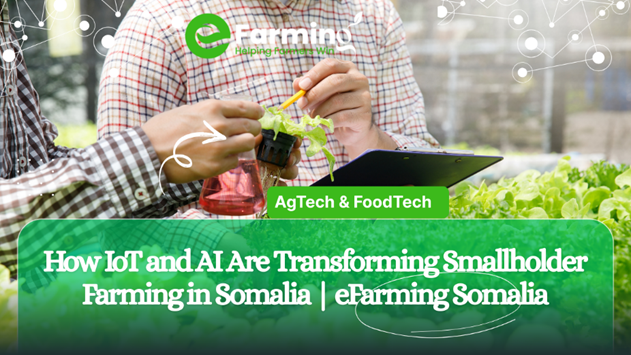
Smallholder farmers are the backbone of Somalia’s agriculture sector, accounting for the majority of domestic food production and supporting millions of livelihoods across rural communities. From irrigated farming along the Shabelle and Juba rivers to rain-fed agriculture and agro-pastoral systems in central and southern regions, smallholders play a vital role in national food security and economic stability.
Despite their importance, smallholder farmers in Somalia continue to face deep-rooted challenges. Climate variability, water scarcity, low productivity, livestock disease outbreaks, and limited access to timely information constrain their ability to farm efficiently and sustainably. These challenges are further compounded by weak access to modern technologies and advisory services, leaving farmers vulnerable to shocks and limiting their capacity to invest in improved practices.
In recent years, emerging digital technologies—particularly the Internet of Things (IoT) and Artificial Intelligence (AI)—have begun to reshape agricultural systems globally. This article explores how IoT and AI are transforming smallholder farming in Somalia, examining how these technologies improve decision-making, resource efficiency, productivity, and resilience, while supporting the transition toward more modern, data-driven agricultural systems.
Digital Technologies and Smart Farming Systems
Smart farming systems rely on the integration of connected technologies to collect, analyse, and act on farm-level data. IoT refers to the use of sensors and connected devices that monitor real-time conditions such as soil moisture, temperature, humidity, water availability, and livestock movement. AI builds on this data by analysing patterns, predicting risks, and generating recommendations that support better farm management decisions.
For smallholder farmers in Somalia, the combination of IoT and AI represents a shift away from reactive farming toward proactive and predictive agriculture. These technologies reduce uncertainty by providing real-time visibility into farm conditions, enabling farmers to respond more effectively to environmental and production challenges.
Data-Driven Farm Management and Productivity
One of the most significant impacts of IoT and AI is improved farm productivity through data-driven management. IoT sensors placed in fields collect continuous data on soil and crop conditions. AI systems analyse this data to recommend optimal planting times, irrigation schedules, and input use.
In Somalia, where rainfall is increasingly unpredictable and water resources are limited, precision irrigation supported by IoT helps farmers use water more efficiently while improving crop yields. AI-driven insights also reduce overuse of fertilisers and inputs, lowering production costs and minimising environmental stress. This leads to healthier crops, higher output, and more sustainable farming practices.
Climate Monitoring and Risk Prediction
Climate variability is one of the most serious threats facing Somali smallholder farmers. IoT-enabled weather stations and environmental sensors generate localised climate data that is far more accurate than broad regional forecasts. AI models process this information to predict weather patterns, drought risks, pest infestations, and disease outbreaks.
With access to these predictive insights, farmers can adjust planting decisions, protect crops in advance of extreme weather events, and take preventive action against pests and diseases. This form of climate-smart agriculture strengthens resilience, reduces losses, and improves long-term farm stability in a fragile climatic context.
Livestock Monitoring and Pastoral Systems
Livestock remains a cornerstone of Somalia’s economy and export earnings. IoT technologies such as GPS tracking devices and animal health sensors are increasingly relevant for monitoring herd movement, grazing patterns, and animal health. AI systems analyse behavioural and health data to detect early signs of illness, stress, or abnormal movement.
For pastoral and agro-pastoral communities, early disease detection and improved herd management can significantly reduce mortality and protect livelihoods. These technologies also support better rangeland management, helping pastoralists make informed decisions about migration routes and grazing pressure, particularly during drought periods.
AI-Powered Advisory and Knowledge Services
AI is transforming how agricultural knowledge reaches smallholder farmers. By combining data from IoT sensors, satellite imagery, historical farm records, and climate models, AI-powered advisory systems deliver personalised recommendations tailored to specific locations and conditions.
In Somalia, where traditional extension services are limited, digital advisory platforms provide farmers with practical guidance on crop management, pest control, livestock health, and post-harvest handling through mobile phones. This personalised, context-aware approach improves productivity and decision-making far more effectively than generic advice.
Market Readiness and Data-Enabled Value Chains
Beyond production, IoT and AI also strengthen farmers’ readiness for markets. Farm-level data enables better prediction of harvest volumes and timing, improving coordination with buyers, aggregators, and processors. AI systems help assess quality, traceability, and consistency, which are increasingly important for structured and export markets.
In Somalia, platforms such as eFarming Somalia play a critical role in translating farm data into actionable market insights. By combining digital advisory services with market access support, eFarming Somalia helps smallholder farmers use technology not only to grow more, but to sell better—strengthening trust, transparency, and value chain integration.
Overcoming Barriers to Adoption
Despite their transformative potential, IoT and AI technologies face adoption barriers in smallholder contexts. These include affordability, limited digital literacy, infrastructure constraints, and concerns around data ownership and trust. Without proper guidance, technology risks remaining inaccessible to the farmers who need it most.
Addressing these barriers requires locally adapted solutions, phased adoption models, and strong farmer support systems. Digital agriculture platforms, development partners, and private innovators must work together to ensure technologies are affordable, user-friendly, and aligned with local farming realities.
Facilitating the Future of Smart Agriculture
IoT and AI have the potential to fundamentally transform smallholder farming in Somalia, but technology alone is not enough. Achieving meaningful impact requires partnerships, capacity building, and inclusive design that places farmers at the centre of innovation.
Through guidance, integration, and ecosystem development, platforms such as eFarming Somalia demonstrate how smart agriculture can be applied responsibly and effectively in fragile contexts. When combined with supportive policies and investment, IoT and AI can help Somali smallholder farmers move toward a more productive, resilient, and market-oriented agricultural future.